
Lorena Lane McNeil
| Lorena Lane McNeil | |
|---|---|

| |
| Lorena circa 1927, likely in Lily Dale | |
| Birth name | Lorena Lane McNeil |
| Married name | Lorena McClure |
| Birth date | November 26, 1886 |
| Birth place | Elmira, New York, United States |
| Death date | July 5, 1953 |
| Death place | Collins, New York, United States |
| Resting place | Cassadaga Cemetery, Cassadaga, New York |
| Spouse | William Francis McClure |
| Children | Fannie McClure, Thelma McClure |
| Father | Charles D. McNeil |
| Mother | Fannie R. McNeil |
| Signature | 
|
Lorena Lane McNeil (1886–1953) was an American schoolteacher and the mother of Fannie McClure, later Fannie Swift, matriarch of the Swift family. Born and educated in Elmira, New York, Lorena came of age during a time of expanding opportunities for women in education and public service. Her early life reflects ambition, mobility, and deep family devotion—but her later years were marked by personal hardship and long-term institutionalization at Gowanda State Hospital, a chapter of her life remembered with sadness and complexity. Through surviving letters, she remains a vivid and emotionally resonant figure in the family’s multigenerational story.
Early Life and Education
[edit]Lorena Lane McNeil was born on November 26, 18861, in Elmira, New York to Charles D. McNeil and Fannie R. McNeil1. She was baptized on June 9, 1895 at the Lake Street Presbyterian Church2, marking her early place in a religious and middle-class Presbyterian household.
By age 13, Lorena was living with her parents and younger brother, Howard McNeil, at 404 Sullivan Street in Elmira3. She was attending school, was literate, and had completed ten months of instruction in the prior academic year3—clear signs of a family that valued education.
At age 16, she appeared in the 1903 Elmira City Directory listed as a student4. At a time when many girls left school by age 14 to enter the workforce or focus on domestic roles, being publicly recorded as a student at 16 reflected both her ambition and her family’s support for extended schooling.
By the 1905 New York State Census, 19-year-old Lorena was still living at home with her family, which now included a boarder, M. Elizabeth Clark5, possibly taken in to help with household income. During this time, Lorena was either completing her education or preparing for a teaching career.
Her educational trajectory culminated in graduation from the Cortland Normal School (now SUNY Cortland), where she earned a Life Teaching Certificate6 that granted her permanent eligibility to teach in New York State. Later documentation also shows that she pursued further academic work through the New York State College for Teachers at Albany (now SUNY Albany)7, perhaps for additional certification or continuing education. This dedication to formal schooling positioned Lorena among a rising class of professionally trained women educators in the early 20th century.
- See Also: Letters of Lorena McNeil (Early Years)
By 1916, Lorena had relocated to Passaic, New Jersey, where she was working as a teacher8. That summer, at age 29, she traveled back to western New York to marry William Francis McClure on July 19, 1916 in Dunkirk, Chautauqua County8. While the couple would eventually live in Lily Dale, William was not originally from there. He had previously been married and had a daughter, Thelma McClure (later Thelma Berry)9. This marriage made Lorena a stepmother, in addition to her later role as a mother.
By 1920, the McClures were living in Cleveland, Ohio10, where Lorena continued her teaching career. The household included her husband William McClure, their young daughter Fannie McClure, and Lorena’s mother Fannie R. McNeil10. Lorena was then 35 years old, and her employment as a teacher is noted in both the 1920 and 1930 U.S. Censuses11, where she is recorded as working in public schools while raising Fannie. Their 1930 home was located on East 84th Street in Cleveland—a modest, urban residential neighborhood.
By the 1930s, the family had relocated to Lily Dale12, a small hamlet known for its spiritualist community. William McClure worked odd jobs and tended their garden, while Lorena continued to emphasize education and discipline in her letters to Fannie. Their home at 3 South Street became a familiar setting referenced in family correspondence for years to come.
As Fannie McClure grew up, married Charles Alfred Swift, and had children of her own, Lorena’s role transitioned from mother to grandmother. Letters from this period show Lorena as warm, opinionated, deeply interested in family matters, and sometimes critical—but always invested. She offered advice, asked questions about the grandchildren, and voiced disappointment when letters or visits were infrequent13.
Institutionalization at Gowanda State Hospital
[edit]Sometime in the early 1940s, Lorena was admitted to Gowanda State Hospital, a psychiatric institution in Collins, New York14. The precise circumstances of her institutionalization are not documented in surviving records, but by the time of the 1950 U.S. Census, Lorena was officially listed as a patient there15. She was 66 years old, widowed, and described with the institutional term "inmate"—a common but impersonal classification in mid-century census documents.
Lorena remained institutionalized for at least a decade. During this time, she wrote dozens of letters to her daughter Fannie and grandchildren16. These letters—often warm and articulate—reveal her longing to maintain familial bonds, even from behind the walls of a hospital. She signed off as "Mother," "Mom," or "Grandma Mac," and routinely inquired about birthdays, illnesses, holidays, and school updates. She asked after Billy, Diane, Patricia, and later Cynthia—though it’s telling that she learned about Cynthia’s birth from a nurse who had read about it in the newspaper17.
Despite occasional glimmers of hope, Lorena’s tone often reflected emotional strain. She expressed confusion, sadness, and frustration, sometimes wondering aloud what she had done to be kept there so long. As the years passed, her ward assignments became more restrictive18, a shift that may suggest a perceived deterioration or a bureaucratic reclassification rather than clinical decline.
Yet Lorena remained intellectually sharp and spiritually attuned. She referenced books, poetry, and scripture19. She described the hospital’s grounds, the daily routine, and her fellow patients with clarity and curiosity. Above all, her letters show that she clung fiercely to her identity as a mother, a grandmother, and a person of value—no matter how society had labeled her.
Death and Discrepancy in Records
[edit]Lorena McClure died on July 5, 1953 at the age of 6920. Her obituary, published shortly after her passing, states that she died at her home at 3 South Street in Lily Dale, following a long illness21.
However, official New York State records tell a different story. The New York State Death Index lists her place of death as Collins, Erie County—the location of the Gowanda State Hospital22. Her cause of death was recorded as a cerebral hemorrhage (code 420), and the corresponding death certificate is filed under number 43563. Notably, the index contains a clerical error, listing her surname as “McClura,” which is corrected in the Ancestry.com transcription22.
This discrepancy suggests that while her official place of death was the hospital in Collins, her obituary may have been worded deliberately—perhaps to preserve privacy, respect community perceptions, or reflect a sentimental connection to her home in Lily Dale. The difference between public announcement and institutional record highlights the stigma that often surrounded mental health care in mid-20th-century America, as well as the family’s possible effort to frame her passing in more familiar and comforting terms.
Lorena was buried at Cassadaga Cemetery23. View on Find a Grave. Years later, the ashes of her daughter Fannie McClure Swift were interred with her—reuniting the two in death after many years of physical and emotional separation.
Unanswered Questions
[edit]What triggered Lorena’s institutionalization, and who authorized it? No surviving records explain how or why she was admitted to Gowanda State Hospital in the early 1940s.
How did Lorena meet William McClure? Their early relationship is undocumented, leaving unknown the context in which they became engaged and married.
Was spiritualism a meaningful part of her life? Despite living in Lily Dale, a center of American spiritualism, her letters contain almost no reference to spiritualist beliefs or practices.
What kind of teacher was she? While census and certification records confirm her profession, details of her classroom experience and career impact are not known.
Did other family members maintain contact during her confinement? Apart from her daughter Fannie, it is unclear whether siblings, stepchildren, or extended family supported her or remained in touch while she was institutionalized.
What caused the emotional distance between Lorena and Fannie? Lorena’s letters express longing and disappointment, but never explain why Fannie withheld news, limited visits, or became so distant over time.
Why does her obituary claim she died at home? Her death certificate lists Gowanda State Hospital as her place of death, yet the obituary says she died at home — possibly to avoid stigma or protect family privacy.
Images related to Lorena McClure
[edit]-
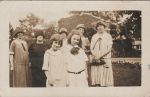 Lorena McNeil on the far right in the background. Fannie McClure on the left in the foreground. Circa 1927.
 -
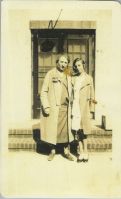 Lorena with Fannie again
 -
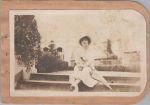 Young Lorena
 -
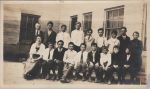 Lorena, the teacher
 -
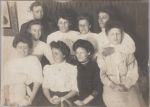 Young Lorena on far right


References
[edit]- Lorena Biographical Information.docx – Birthdate, parents
- Baptism record, Lake Street Presbyterian Church, as cited in Lorena Biographical Information.docx
- 1900 U.S. Federal Census – Address, education status
- 1903 Elmira City Directory
- 1905 NY State Census – Household composition
- Cortland Normal School Transcript
- Credit evaluation from NYS College for Teachers at Albany
- Marriage record, July 1916, Dunkirk NY (Lorena Biographical Information.docx)
- Letter mentions and family documentation of Thelma
- 1920 U.S. Census – Cleveland household
- 1930 U.S. Census – Employment and residence
- Letter mentions and Lily Dale residence records
- Lorena Letters – Tone and content about grandchildren
- 1950 U.S. Census – Institutional listing at Gowanda
- U.S. Census; Lorena Letter mentions
- Lorena Letters – Dozens written from GSH
- Lorena Letters – Learning about Cynthia’s birth via nurse
- Escape to Utopia thesis, ward restriction descriptions
- Lorena Letters – Biblical and literary references
- NY Death Index and obituary discrepancy
- The Fredonia Censor obituary
- NY State Death Index, Ancestry transcription
- Find a Grave memorial #10437800
| McClure Family | Lorena Lane McNeil · William Francis McClure · Fannie McClure |
|---|---|
| Swift Family | Charles Alfred Swift · Diane Swift · Billy Swift · Patricia Swift · Cynthia Swift · Sidney Swift |
| Places | 3 South Street · Pagoda · The Stump · Cassadaga Cemetery |
| Institutions and Topics | Gowanda State Hospital · Spiritualism · Letters from Gowanda · The Titanic Legend |